
HMRC Fined My Dormant UK Company £800. I Submitted One Form, and 9 Days Later Both Penalties Were Reduced to £0
This post was translated from Chinese by AI. If anything reads oddly, the Chinese original is authoritative. 中文原文
Last year, I wrote about renewing a UK company for its second year. At the time, I thought filing a confirmation statement and dormant accounts each year was all I needed to do. Then, in September this year, HMRC (HM Revenue & Customs) sent me two Corporation Tax late-filing penalties: £400 each, £800 in total.
What happened next was unexpected: I never submitted an appeal or filed the missing returns, and I didn't spend a penny. 9 days later, HMRC reduced both penalties to £0 on its own. Here's what the letters said and what I did. If you've registered a UK Ltd that has never actually traded, this may be useful.
A quick disclaimer: I'm not an accountant. This is just my experience with one company. HMRC handles cases individually, so following the same steps doesn't guarantee the same outcome.
Timeline
| Date | What happened |
|---|---|
| 2024-04-03 | Registered the company through 1st Formations, using their virtual office as the registered address |
| 2025-05-18 | HMRC issued two notices to deliver a Company Tax Return (CT603), covering two separate periods |
| 2025-06-03 | Filed AA02 dormant accounts with Companies House, which were accepted. I thought that was everything sorted |
| 2026-09-07 | HMRC issued two CT211 penalties of £400 each, payable or appealable within 30 days, with a deadline of 2026-10-07 |
| 2026-09-15 | Submitted an online notification to HMRC that the company had never traded, and requested access to the Corporation Tax online service |
| 2026-09-16 | HMRC issued two "amended penalty determination" letters, reducing the penalties to £0 (I didn't receive these until 9-26) |
| 2026-09-22 | Received the Corporation Tax activation code (a physical letter sent to the registered address, then scanned and forwarded by 1st Formations) |
| 2026-09-23 | Activated the account and saw a balance due of £0, with both periods marked Superseded |
| 2026-09-26 | Received scans of the two letters dated 9-16, confirming in writing that the penalties had been cancelled |
What the penalty notice looked like
Here's the first penalty notice (company name, address, and tax reference redacted):
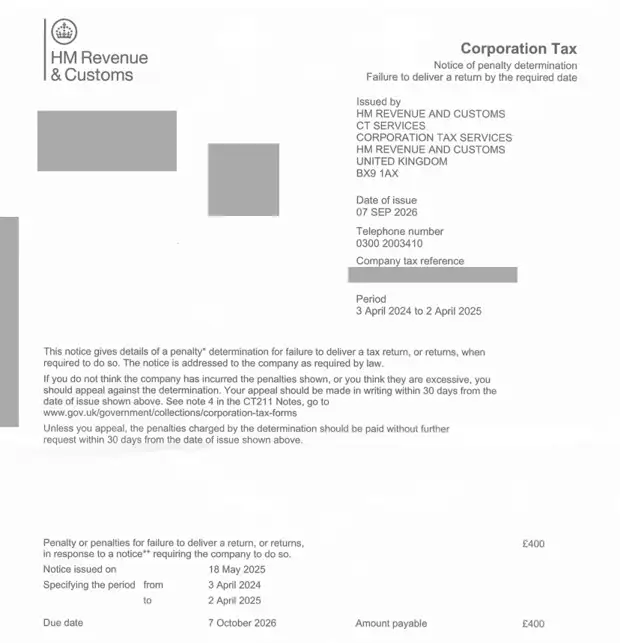
A few key details:
- The heading is Notice of penalty determination / Failure to deliver a return by the required date, meaning the Company Tax Return wasn't filed by the deadline
- Notice issued on 18 May 2025: HMRC considers this the date it notified you to file
- Period: this notice covers 2024-04-03 to 2025-04-02; the other covers 2025-04-03 to 2025-04-30
- £400: under gov.uk's late-filing penalty rules, filing 1 day late incurs £200, with another £200 after 3 months, making £400
- The second page is a statement showing 0.00 under Tax and 400.00 in penalties. In other words, the company owed no tax at all; the penalty was purely for not filing
- The letter says you can appeal in writing within 30 days; otherwise, payment is due within 30 days
Why were there two periods in one year? The company's first financial year ran from incorporation to 2025-04-30, spanning 13 months. A Corporation Tax accounting period can be no longer than 12 months, so HMRC split it into "12 months + 1 month", with separate notices and penalties for each.
Why I was fined
Put simply, Companies House and HMRC are separate systems. Filing dormant accounts with one doesn't notify the other.
I filed a confirmation statement and AA02 dormant accounts with Companies House each year, assuming that registered the company as "dormant". But Corporation Tax is handled by HMRC. Once HMRC issues a CT603 (Notice to deliver a Company Tax Return), you must file a CT600 Company Tax Return or tell HMRC that the company is dormant.
Those two CT603 notices had actually arrived at the registered address in May 2025, and 1st Formations had scanned and emailed them to me. I just hadn't taken them seriously. So "I didn't receive the notice" wasn't a reason I could use in an appeal.
What I did
1. Told HMRC the company had never traded
The gov.uk guidance on dormancy for Corporation Tax is clear: a newly incorporated company that hasn't started trading and has no other income is usually considered dormant for Corporation Tax, and you can proactively tell HMRC.
I first registered a Government Gateway account, then completed the online form "Tell HMRC your organisation has stopped trading or has never traded". It asks for very little:
- Whether you're an agent: No
- Your name, company name, and Corporation Tax UTR (the ten-digit Unique Taxpayer Reference shown on the CT603 and penalty notices)
- Company type: Limited company
- Your role: Director
- Has the company ever come under the charge of Corporation Tax (whether the company has ever been liable for Corporation Tax): No—this is the most important question
- Declaration: I agree
After submitting, you get a submission reference and receipt. Save them. This step took 5 minutes and cost nothing.
2. Set up online access to Corporation Tax at the same time
Add the Corporation Tax service in HMRC's Business Tax Account. HMRC posts an activation code to the company's registered address. Mine took about a week to reach me through 1st Formations, and the code was valid for 30 days.
Once activated, you can view the status and penalty details for each period online.
3. Prepared a plan B
I wasn't sure whether HMRC would act on the dormancy notification, so I prepared an alternative:
- File nil returns: HMRC's own online filing service closed on 2026-03-31, so CT600 returns now have to be filed using commercial software. I compared two providers: WeFile's dormant tier at £15/return and TinyTax's dormant option at £20/year (prices checked in September 2026)
- Appeal in writing: gov.uk has a late-filing penalty appeal form. You need one form per penalty and must complete it in one sitting, as you can't save your progress. Then print, sign, and post it. Note that the official requirement is to file the return before appealing
- HMRC's courier address is different from its postal address: the BX9 1AX postcode can only be used with Royal Mail. International couriers must deliver to the Central Mail Unit in Newcastle, with a note inside the envelope asking for it to be forwarded to CT Services
Also worth noting: officially, neither "it's my first time" nor "I didn't know I had to file" is a reasonable excuse on its own. My planned explanation was that the company had never traded or received income since incorporation, owed no tax, this was a first-time and unintentional failure, and the missing returns had now been filed.
4. Checked the status after activating the account
When I activated the account on September 23, the balance due was £0, both periods were marked Superseded, and the Penalties column showed 0.00.
I didn't have written confirmation yet, so I saved screenshots of these pages with the URLs and dates visible. If the penalties ever reappeared, those screenshots could serve as evidence for an appeal. I also put the missing returns on hold: since the periods had already been withdrawn, submitting returns might just result in them being rejected.
5. Received written confirmation
On September 26, 1st Formations forwarded two letters from HMRC. Both were dated September 16, the day after I submitted the dormancy notification:
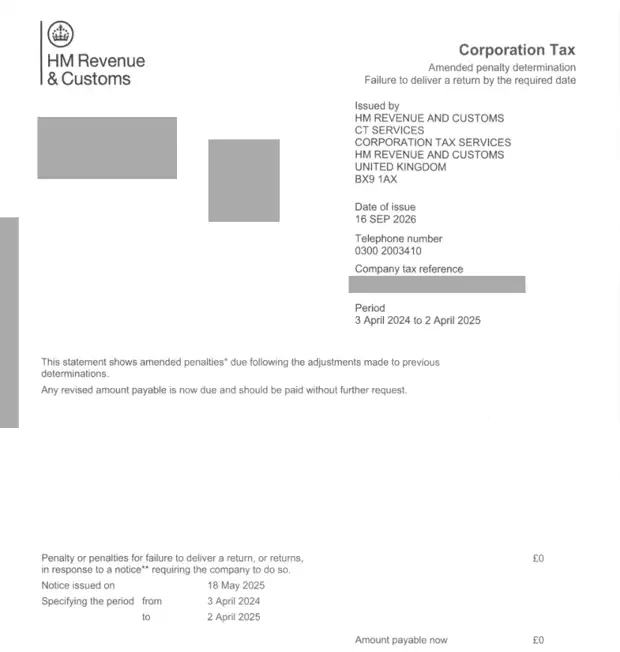
The heading was Amended penalty determination, and the letters stated that, following adjustments to the previous decisions, the penalties had been reduced to £0. There was one letter for each penalty, and that settled it. Honestly, I'd been prepared to spend £30 filing the missing returns and then write an appeal. I hadn't expected one form to resolve everything.
Lessons learned
The biggest trap was assuming that filing dormant accounts with Companies House meant HMRC knew about it too. You need to deal with each separately, and you must respond to any CT603 from HMRC.
If you use a virtual office, HMRC's letters arrive on paper at the registered address and then have to be scanned and forwarded. That takes about a week, leaving you less time than the letter suggests. Read the scans when they arrive—don't leave them for over a year like I did.
If you receive a penalty, don't rush to pay it. If the company genuinely never traded, submit a dormancy notification first, then check the period status in your account. But keep an eye on the 30-day appeal deadline. If it's approaching and you haven't heard anything, follow the appeal process.
Two more points to make clear:
- This outcome isn't the rule. gov.uk says that if you've received a notice to file, you still need to submit a return showing that the company was dormant for that period. In my case, HMRC withdrew the periods outright; another case may turn out differently
- Dormancy has conditions. According to gov.uk, receiving interest counts as income too. My company later earned a little interest in its Wise account, so I'll need to register for Corporation Tax again and file returns on time. I haven't done that step yet—I'll write about it once I have
Throughout the process, I used AI to help read the scanned letters, put together a timeline, check the official guidance, and add reminders for all the deadlines to my calendar. If you’re in a similar situation or also using a UK company, feel free to join the discussion on SunAI Forum, the tech community I run.
Comments 0