
Formal Salutations and Closings for Letters
This post was translated from Chinese by AI. If anything reads oddly, the Chinese original is authoritative. 中文原文
Opening Salutations
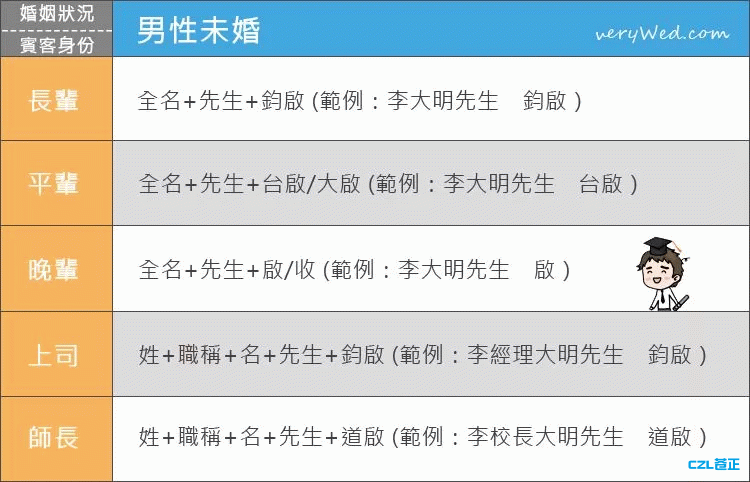
Closing Courtesies:
1、Greetings and Well-Wishes:
For grandparents and parents: With a respectful bow, I wish you good health; respectfully wishing you blessings and peace; solemnly wishing you good health.
For older relatives and friends: Respectfully wishing you blessings and peace; respectfully wishing you well; bowing respectfully and wishing you peace; wishing you well; respectfully wishing you health in your later years; sincerely wishing you good health.
For teachers: Respectfully wishing you well in your teaching; respectfully wishing your teachings to flourish; solemnly wishing you peace; sincerely wishing you well in your lectures.
For relatives and friends of the same generation: Wishing you happiness and continued well-being; wishing you well in daily life; wishing you good health; respectfully wishing you peace; wishing you seasonal well-being.
For younger relatives and friends: Asking how you have been lately; asking whether all is well; adding my wishes for your peace and well-being.
For those living with their grandparents or parents: Respectfully wishing you well as you care for your elders; respectfully wishing you blessings in attending to them; also wishing you happiness in their company.
For married couples living together: Respectfully wishing you marital harmony; wishing you both well; respectfully wishing you happiness as a couple.
For those in government: Respectfully wishing you well in public service; respectfully wishing you good health; wishing you well in your official duties.
For those in the military: Respectfully wishing you well in military service; respectfully wishing you well in command; solemnly wishing you victory and peace.
For those in academia: Wishing you success in your writing; wishing you well in your scholarly work; wishing you well; wishing you literary success; also wishing you well in your studies; wishing you peace in your writing; wishing you literary good fortune.
For those in business: Wishing you financial well-being; respectfully wishing you success in your business affairs; wishing you good fortune in your endeavors.
For travelers: Respectfully wishing you safe travels; extending wishes for a fortunate journey; asking after your well-being on the road.
For those at home: Respectfully wishing you peace at home; also wishing your household blessings; wishing you happiness at home.
For wedding congratulations: Respectfully wishing you marital joy; congratulations on your joyous occasion; respectfully wishing you happiness.
For New Year greetings: Wishing you a happy year; wishing you a happy New Year; wishing you blessings for the year ahead.
For condolences: Thinking of you during your mourning; asking after you in your bereavement; especially wishing you well during this time of mourning.
For inquiries about illness: Respectfully wishing you a good recovery; wishing you good health; respectfully wishing you a speedy recovery.
For seasonal greetings: Respectfully wishing you a peaceful spring; wishing you springtime blessings; respectfully wishing you a peaceful summer; also wishing you well in the summer heat; respectfully wishing you a peaceful autumn; also wishing you autumn well-being; respectfully wishing you a peaceful winter; wishing you warmth and peace; respectfully wishing you comfort by the hearth.
For greetings at different times of day: Wishing you a good morning; wishing you well this morning; wishing you a good afternoon; wishing you a good evening; wishing you well at this moment; wishing you a pleasant day; wishing you well at this time.
2、Courtesies Below the Signature:
For grandparents and parents: Presented with a bow; respectfully submitted; humbly submitted; solemnly submitted; sincerely submitted; offered with a bow.
For respected elders: Sincerely submitted; sincerely yours; humbly yours; with sincere respect; respectfully yours; respectfully written; sincerely written.
For peers: Sincerely written; sincerely stated; written personally; personally submitted; with a respectful bow; humbly written; submitted in writing; humbly stated; written; submitted; stated.
For younger people: Personally instructed; personally conveyed; personally written; personally drafted; briefly conveyed; instructed.
For replies: Respectfully replying; personally replying; sincerely replying; in reply.
For unsigned letters: Respectfully yours, with my name supplied separately (a calling card enclosed); with mutual understanding and respect; with mutual understanding; trusting you will recognize me and forgive the omission; known to us both..
For postscripts: A further note; also; a further statement; one more note; one more statement.
3、Additional Greetings:
Greetings to elders: Please convey my respectful greetings by name to your honored father (or mother). I have not written separately to your uncle; please convey my respectful greetings by name.
Greetings to peers: Please convey my regards to your brother; I will not write separately. I have not had time to write separately to your brother; please convey my regards.
Greetings to younger people: Please also convey my best wishes to your son. Please also ask how your sons have been lately.
Greetings on behalf of elders: My father has asked me to send his regards. My uncle has asked me to send his regards.
Greetings on behalf of peers: My elder brother adds his respectful greetings; our friend also sends his regards.
Greetings on behalf of children: My son joins me in a respectful bow. My grandson also bows respectfully. So-and-so has asked me to convey respectful greetings.
“Wishing you continued success in business”: “wishing” here means adding a courteous wish, while “qi” means good fortune and well-being. Decades ago, when letters were written in Classical Chinese,
this character appeared in the closing greetings. If you were studying, you would write “good fortune in your studies.” Common forms included “seasonal
good fortune” and “summer good fortune” (in summer). If you were doing business, you would write “good fortune in business,” wishing the recipient success and prosperity. Literally,
“wishing you continued success in business” means “taking this opportunity to wish you smooth business growth.” Today, it is simply a closing used in business correspondence, equivalent to
“Yours sincerely” in an everyday letter.
In older letters, you often see blessings of the form “X good fortune,” “X peace,” “X blessings,” “X happiness,” or “X luck,”
such as “business good fortune,” “literary good fortune,” “continued good fortune,” “peace in your endeavors,” “peace in your virtuous life,” “peace while away from home,” “winter peace,” “financial well-being,” “abundant blessings,” “happiness for the
year,” “New Year happiness,” and “spring happiness.”
The wording of these wishes depends on the recipient's generation and status. For elders, people generally used “respectfully wishing you blessings and peace” or “respectfully wishing you
great good fortune.” Similarly, letters to superiors generally used phrases such as “humbly wishing,” “respectfully wishing,” and “reverently wishing.” For peers, people generally used “wishing you good health”
or “wishing you success in business.” For younger people, a simple “asking after you” was sufficient.
{callout}
To summarize:
1、This is a conventional expression from business correspondence a very long time ago..
2、It was probably a courtesy used between businesses before the founding of the People's Republic of China.
3、It appears at the end of a letter.
4、It is similar to the common closing “Yours sincerely.”
5、It expresses good wishes.
6、If it must be put into plain language, it means: May everything go well with your business!
7、That is roughly the meaning. It is similar to “Best Regards” in English.
8、It still occasionally appears in business correspondence with Hong Kong, Taiwan, and other places.
9、You can also write: Wishing you success in business! Wishing you well in business!
10、Note that the character is “颂” (to express wishes), not “送” (to send).
11、There are also seasonal versions. In autumn, for example, you can write “wishing you autumn peace,” or use “summer peace” or “winter good fortune.”
12、However, “spring good fortune” is not used.
{/callout}
Last updated 2024-01-14
Comments 0